 Vistara Group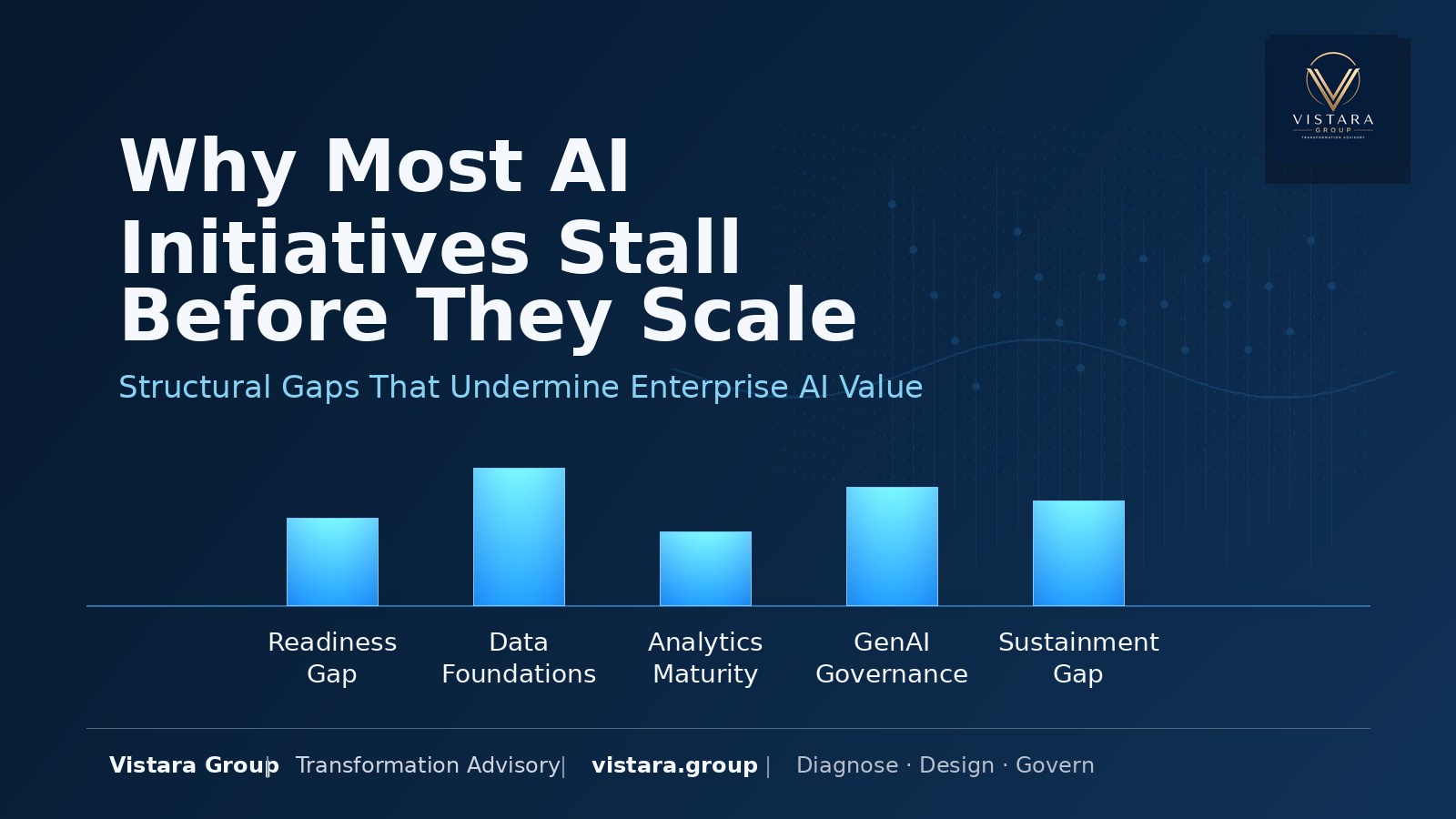
AI failure is often misdiagnosed
Many AI programs begin with a clear business case, a funded technology plan, and a capable delivery team. The model is built. The platform is integrated. A pilot shows promise. Then the program slows, adoption fragments, and value realization becomes difficult to explain.
The issue is rarely the model alone
The deeper issue is structural. The organization has not clearly defined who owns the decision, which data can be trusted, how model output will be governed, how frontline users will adopt the recommendation, and who remains accountable after go-live.
Delivery success is not value success
Traditional delivery governance asks whether scope, timeline, budget, and vendor execution are on track. Those questions matter, but they do not answer whether AI is becoming a usable and trusted business capability.
The structural gap
AI scales only when the operating model around it is designed with the same discipline as the technology. Decision rights, override rules, monitoring, privacy boundaries, data ownership, adoption signals, and value accountability must be designed before scale.
Executive implication
Senior leaders should not ask only whether AI is ready to deploy. They should ask whether the organization is ready to rely on it. That is a different governance question, and it requires a different operating model conversation.
Sivakumar Gopalakrishnan is Founder & Managing Partner of Vistara Group. His experience spans transformation leadership, governance, data and AI, operating models, platform modernization, portfolio oversight and value realization across financial services, retail, fuel and public-sector organizations.